The first warm week of spring rolls through Kansas City and the floors tell on themselves. Salt halos near every entrance. Faded traffic lanes from the lobby to the elevator. Cloudy finish where clear gloss used to live. After a Midwest winter, commercial floors in Kansas City need some help. The question is how much.
Two methods sit on the table: top scrub and recoat, or a full strip and refinish. One is faster, cheaper, and keeps the building open. The other is slower, more thorough, and resets the floor for years to come. Picking the wrong one wastes labor, burns through finish, and shortens the floor’s life. Picking the right one is one of the most important floor care decisions a facility manager makes every year.
Here is how to read your floor, understand the trade offs, and build a plan that fits your facility.
Why This Decision Matters
Commercial floor finish is a sacrificial layer. It takes the hits from carts, heels, grit, and ice melt so the tile underneath does not. Over time, that layer gets scratched, embedded with soil, and thin in the places where traffic is heaviest. The job of a floor care program is to keep a healthy layer of finish on the floor at all times, using the least invasive method that still gets the job done.
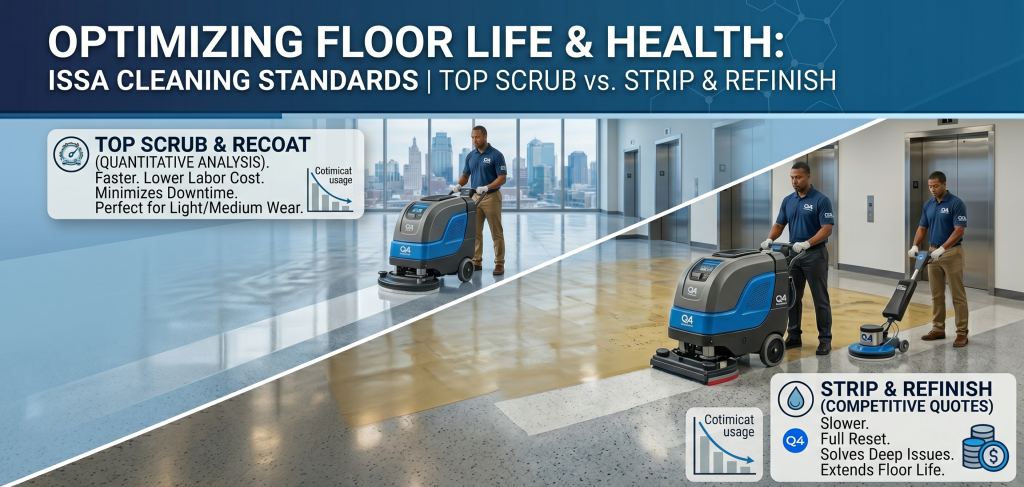
Top scrub and recoat is less invasive. Strip and refinish resets the whole surface. Using the right one at the right time protects the floor, the budget, and the occupant experience.
What Top Scrub and Recoat Actually Means
Top scrub and recoat removes the top one or two worn layers of finish, cleans the floor, then applies two to three fresh coats. The existing base layers stay. The process is sometimes called a scrub and recoat or a flash recoat.
When it fits
- Finish still has healthy thickness, just dulled or lightly scratched
- No signs of yellowing, edge curl, or finish failure
- 12 months or less since the last full strip and refinish
- Building stays open or has only a short after hours window
- Healthcare, schools, and offices where downtime is expensive
Typical process
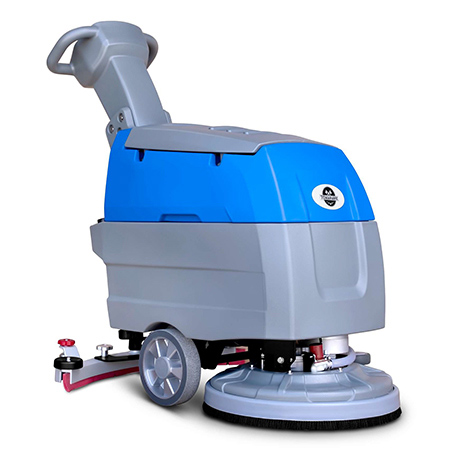
A light alkaline scrubbing solution, an auto scrubber with a blue or green pad, a thorough rinse, and two to three coats of compatible finish applied with a T bar or microfiber applicator.
Advantages
Faster, less labor, less chemical, less downtime. A single tech can often top scrub and recoat several hundred square feet in a single shift. The finish takes fewer hours to cure because the build is lighter.
Limits
Top scrub and recoat is a maintenance step, not a restoration step. If the floor has yellowed, curled, or worn down to the tile, this method will not fix it.
What Strip and Refinish Actually Means
Strip and refinish removes every existing layer of finish all the way down to the substrate, then applies a full build of finish from scratch. This is the reset button.
When it fits
- Finish is yellowed, cloudy, or showing edge curl
- Significant wear through to the tile on traffic lanes
- More than 12 to 18 months since the last full strip
- Visible contamination from ice melt, wax buildup, or improper prior coats
- Annual summer maintenance window for schools, government, and similar facilities
Typical process
Stripper solution dwells on the floor, a low speed machine with a stripping pad breaks up the old finish, a wet vacuum picks up the slurry, the floor is neutralized and rinsed, then four to six coats of finish go down with proper dry time between each.
Advantages
Complete restoration. The floor looks new. Finish performance resets, traffic lanes disappear, and the next year of maintenance is easier.
Limits
Labor intensive, chemical intensive, and requires significant downtime. Most strip and refinish jobs run overnight or over a weekend and require careful scheduling around occupants.
The Decision Framework
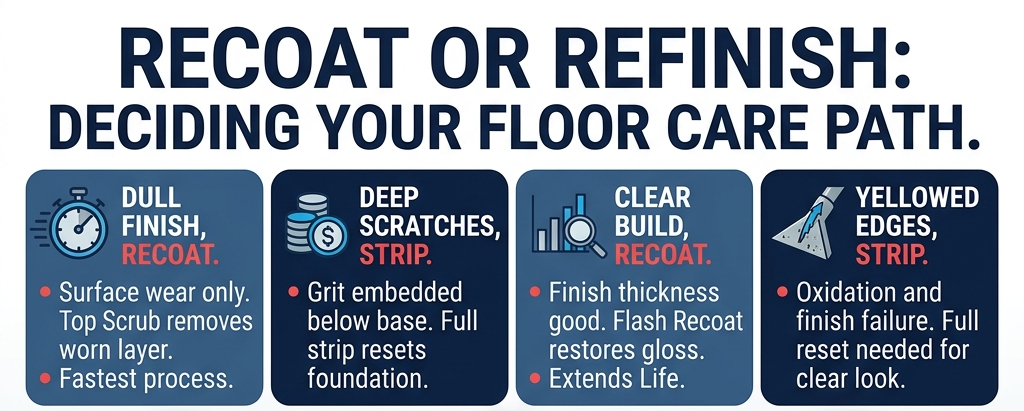
Stand on the floor and ask four questions. The answers point you toward one method or the other.
1. How thick is the remaining finish?
Scratch a small spot with a coin in a back corner. If the coin cuts into a healthy layer of finish, top scrub and recoat is on the table. If it reaches tile quickly, strip and refinish is coming.
2. What does the finish look like?
Clear and scratched says top scrub and recoat. Yellow, cloudy, or showing edge curl says strip and refinish.
3. How long since the last strip?
Under 12 months, lean toward top scrub and recoat. Over 18 months, strip is usually the right call. Between 12 and 18, use the other signals to break the tie.
4. What is the downtime tolerance?
Active hospitals, 24 hour healthcare, and retail spaces often need the lighter touch. Schools and government buildings with a summer break can absorb a full strip without disruption.
Recommendations by Facility Type
Healthcare and senior living. Top scrub and recoat two to three times a year with a full strip every 18 to 24 months. Downtime is the main constraint.
K-12 and higher education. Full strip and refinish during summer break every year or every other year. Top scrub and recoat at winter break and spring break to carry the finish through heavy traffic seasons.
Government and municipal buildings. Annual strip on a scheduled weekend, top scrub and recoat mid year. Budget cycles often dictate the timing more than floor condition does.
Office buildings. Top scrub and recoat after winter, strip every 18 to 24 months during a long weekend. Keeping occupants productive usually outweighs the benefit of a full reset.
Sports and entertainment venues. Strip during the off season, top scrub and recoat between events. High impact and high visibility mean finish has to look sharp.
Common Mistakes to Avoid
Stripping when a recoat would have worked. Each strip thins the underlying tile over time and wastes chemical and labor that was not needed.
Recoating on a dirty floor. Any soil trapped under the new finish becomes permanent until the next strip. Top scrub is non negotiable before recoating.
Applying too few coats. Two thin coats of finish do not build enough sacrificial layer to hold up through the next season.
Mixing incompatible finishes. Always follow the manufacturer technical data sheet. Some finishes do not bond to others, which causes premature failure.
Ignoring entry matting. A clean floor only stays clean if the dirt never reaches it. Quality walk off mats at every entrance extend the life of every coat.
Frequently Asked Questions
How often should commercial floors be stripped and refinished?
Most commercial floors benefit from a full strip and refinish every 12 to 24 months, depending on traffic and how well the interim top scrub and recoat program performs.
Can I recoat a commercial floor without stripping it?
Yes, as long as the existing finish is clean, has healthy thickness, and shows no yellowing or edge curl. This is exactly what top scrub and recoat is designed for.
How many coats of finish should I apply after stripping?
Four to six coats is standard for a full strip and refinish. Two to three coats is standard for a top scrub and recoat. Follow the finish manufacturer guidance for thickness and dry time.
How long does the top scrub and recoat process take?
A typical project runs one overnight shift for a few thousand square feet. Cure time before heavy traffic is usually eight to twelve hours.
What is the best floor finish for a Midwest facility with salt exposure?
Look for a commercial grade finish with high solids content, strong slip resistance, and proven durability on vinyl composition tile. Match the finish to the traffic level and ask your distributor for data sheets.
Setting the Plan for the Year
After a long Kansas City winter, most facilities land in one of three spots. Healthy finish that needs a refresh points to top scrub and recoat. Tired finish with visible wear points to a full strip and refinish. A mix of both across different zones is also common, and zoning the program by area often saves time and money.
Q4 Industries has been equipping facility managers across the Kansas City metro and the Midwest since 2003 with ISSA certified expertise, the floor finishes and equipment trusted by building service contractors, and reliable delivery when your window is tight.
Ready to map out the right method for your floors this spring? Contact the Q4 Industries team to walk through your facility, your schedule, and the supplies that will get you back to a sharp looking surface.