The autonomous floor scrubber has moved out of the trade show demo booth and onto the floors of real Kansas City facilities. Grocery stores, distribution centers, schools, and large office campuses are running autonomous scrubbers on the same overnight shift that used to belong entirely to a walk behind machine and an operator.
That does not mean the walk behind auto scrubber is done. It means facility managers now have a real choice to make, and getting it right depends less on which machine is newer and more on which one actually fits the building, the labor situation, and the budget.
Here is how autonomous and traditional floor scrubbers compare, and where each one earns its place on the cleaning schedule.
What Counts as an Autonomous Floor Scrubber
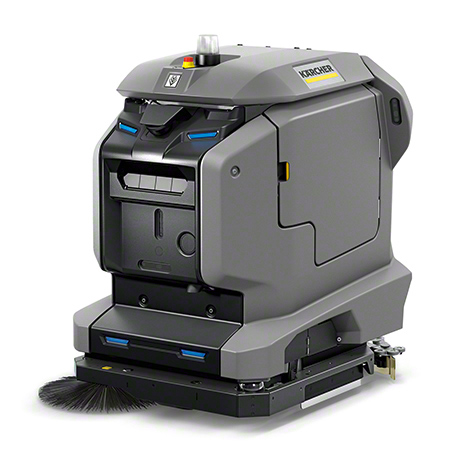
An autonomous floor scrubber is a walk behind style scrubber that has been engineered to map a space, navigate around obstacles and people, and run a scrubbing route without an operator physically pushing or steering it. The operator’s role shifts from driving the machine to supervising it, programming routes, and handling the tasks the machine cannot do.
The Karcher KIRA B 50 is a good example of where this technology has landed. It runs a 22 inch scrub path autonomously, using sensors to map the facility, detect obstacles, and follow a programmed cleaning route without a hand on the machine. A 160 amp hour lithium ion battery delivers roughly three and a half hours of autonomous runtime, and the 14.5 gallon solution and recovery tanks cover close to 20,000 square feet on a single fill.
What Counts as a Traditional Floor Scrubber
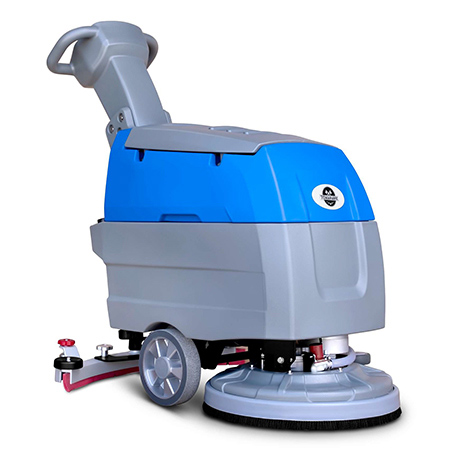
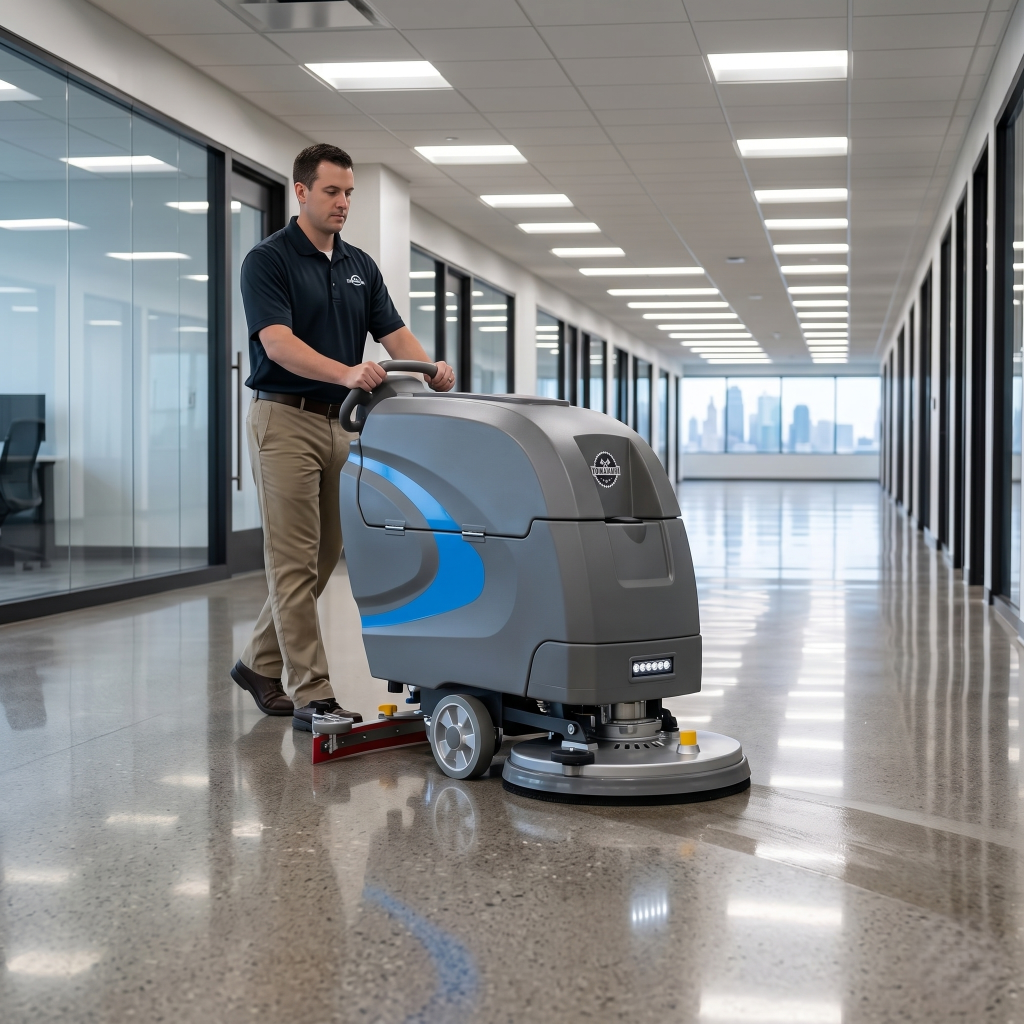
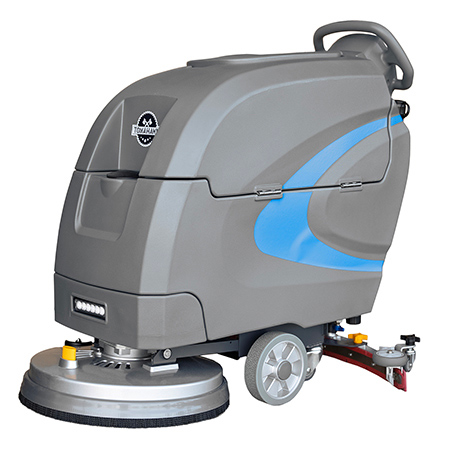
Traditional auto scrubbers, whether walk behind or ride on, still require an operator to steer, apply pressure through the handle, and manage turns around obstacles and people in real time. They come in a wide range of deck widths and tank sizes to match everything from a narrow hallway to a hundred thousand square foot warehouse floor.
Traditional scrubbers are simpler machines with fewer sensors and less onboard software, which generally means a lower upfront cost and a shorter learning curve for a new operator.
Comparing the Two Head to Head
Labor
This is the single biggest difference between the two categories. A traditional scrubber still needs a dedicated operator for every minute it runs. An autonomous scrubber like the KIRA B 50 can run its route while that same staff member handles restroom checks, trash collection, or other tasks elsewhere in the building. For facilities running short staffed shifts, and most are these days, that reallocation of labor is often the entire business case.
Upfront Cost
Traditional scrubbers cost less to purchase. Autonomous scrubbers carry a premium for the navigation sensors, mapping software, and safety systems required to operate without an operator’s direct control. Facilities need to weigh that premium against the labor hours it frees up over the life of the machine.
Consistency
An autonomous scrubber runs the same route, at the same speed, with the same pressure, every single time. A traditional scrubber’s results depend on the operator’s attention, pace, and technique on any given night. Facilities that struggle with inconsistent results from a rotating cast of part time cleaning staff often see the biggest quality improvement from switching a portion of their fleet to autonomous.
Flexibility
Traditional scrubbers win here. An operator can adjust on the fly for a spill, a moved display, an event setup, or a layout that changes daily. Autonomous scrubbers work best in spaces with a fairly stable layout that does not shift dramatically from night to night, since route remapping takes time and a bit of technical comfort.
Maintenance and Troubleshooting
Traditional scrubbers are mechanically simpler, which usually means faster troubleshooting and a wider range of technicians who can service them. Autonomous scrubbers add sensors, mapping computers, and safety systems that require more specialized service, though manufacturers have made significant strides in remote diagnostics and simplified onboard displays.
Where Autonomous Scrubbers Make the Most Sense
- Large, open floor plans such as grocery stores, big box retail, distribution centers, and airport terminals
- Facilities running overnight shifts with limited staff, where freeing up an operator has real labor value
- Buildings with a stable, repeatable layout that does not change dramatically week to week
- Organizations already comfortable managing fleet software, route data, and basic troubleshooting
Where Traditional Scrubbers Still Win
- Smaller or irregularly shaped facilities where the labor savings do not offset the equipment premium
- Spaces with frequent layout changes, events, or furniture moves that a mapped route cannot anticapte
- Facilities without in-house comfort managing fleet software or sensor based equipment
- Budget constrained operations where a lower upfront cost matters more than labor reallocation
A Practical Way to Decide
Start with square footage and staffing. A facility over 50,000 square feet running lean overnight staff is a strong candidate for an autonomous scrubber. A facility under 20,000 square feet, or one with a layout that changes constantly, usually gets more value from a traditional walk behind.
Many Kansas City facilities land on a hybrid fleet. An autonomous scrubber handles the large open corridors and sales floor on a fixed nightly route, while a traditional scrubber covers tighter spaces, detail work, and the areas that change too often for a mapped route to keep up.
Common Mistakes When Evaluating Autonomous Scrubbers Kansas City
Buying without mapping the facility first. Autonomous scrubbers need a clear initial mapping process. Skipping this step, or rushing it, leads to missed areas and inconsistent routes.
Underestimating the training curve. Staff still need training, just a different kind. Understanding how to supervise, restart, and adjust routes matters as much as knowing how to steer a traditional machine.
Ignoring facility layout stability. A facility that rearranges shelving or furniture weekly will spend more time remapping than it saves in labor.
Assuming autonomous means unattended forever. Most facilities still want a staff member nearby during the first several weeks to catch edge cases the machine has not encountered yet.
Frequently Asked Questions
How much square footage can an autonomous floor scrubber cover?
The Karcher KIRA B 50 covers roughly 20,000 square feet per tank fill and runs autonomously for up to three and a half hours on its lithium ion battery before needing a recharge.
Do autonomous floor scrubbers require a dedicated operator?
Not during the scrubbing run itself, but most facilities keep a staff member available to supervise, handle exceptions, and manage the route software, especially in the first weeks of operation.
Are autonomous scrubbers safe to run around people?
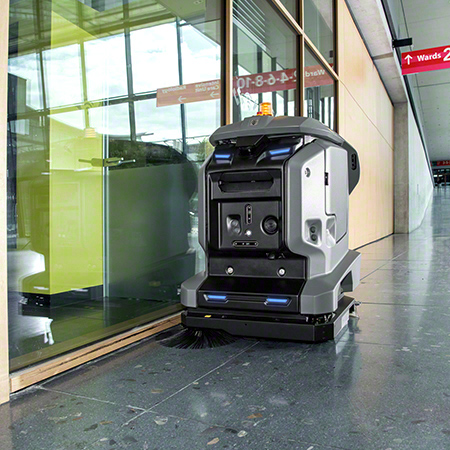
Yes. Machines like the KIRA B 50 use sensors to detect obstacles and people and stop or reroute automatically, which is what allows them to run in occupied or lightly trafficked spaces.
Is a traditional scrubber still a good investment in 2026?
Absolutely. Traditional scrubbers remain the right fit for smaller facilities, irregular layouts, and operations where the labor savings of autonomous equipment do not offset the higher upfront cost.
Can a facility run both autonomous and traditional scrubbers together?
Yes, and many do. A hybrid fleet lets an autonomous scrubber handle large, stable areas while a traditional scrubber covers tighter or frequently changing spaces.
Choosing the Right Fit for Your Facility
Neither autonomous nor traditional floor scrubbers are the universal right answer. The right choice depends on square footage, staffing reality, layout stability, and budget, and for a lot of Kansas City facilities the smartest answer is a mix of both.
Q4 Industries has been equipping facility managers across the Kansas City metro and the Midwest since 2003 with ISSA certified expertise and the floor care equipment that matches real world operating conditions, from the Karcher KIRA B 50 to a full range of traditional walk behind and ride on scrubbers.
Ready to figure out which scrubber fits your building? Contact the Q4 Industries team to walk your facility and map out the right equipment mix.
Why Order Your Floor Scrubbers From Q4 Industries
Q4 Industries has equipped Kansas City metro and Midwest facilities with floor care equipment since 2003, big enough to stock autonomous machines like the Karcher KIRA B 50 and small enough to still walk your floor plan with you before recommending one. Our ISSA certified team helps you match the right scrubber, autonomous or traditional, to your actual labor situation and layout instead of selling the newest machine on the floor.
Browse our full Floor Scrubbers lineup or the broader Floor Cleaning Equipment category. Call 913-894-6240 or 800-815-0245, or visit our contact page to schedule a walkthrough.