Walk into any office building first thing Monday morning and the carpet tells a story. Coffee spills from last week, salt residue from winter boots, and a quiet buildup of dust that settled in over the weekend. Most facility managers know their carpets need attention. The question they keep asking is how often.
Getting the answer right matters. Clean too infrequently and the carpet wears out years before it should, indoor air quality drops, and the space stops feeling professional. Clean too aggressively and you spend budget on a service that was not yet needed. The sweet spot sits somewhere between the two, and it looks different for every building.
This guide breaks down how often office carpets should be deep cleaned, what factors push the schedule in either direction, and how Kansas City and Midwest facility managers can build a routine that protects the carpet, the occupants, and the bottom line.
Why Carpet Cleaning Frequency Matters
Commercial carpet is one of the larger capital investments in any office. A well maintained carpet can last 10 to 15 years. A neglected one rarely sees five. Regular office carpet deep cleaning protects that investment by lifting out the soil, grit, and allergens that vacuuming alone cannot reach.
There is also a health and productivity angle. The Carpet and Rug Institute points to carpet as a filter that traps airborne particles, including pollen and fine dust. When that filter reaches capacity, the particles get kicked back into the air every time someone walks across the floor. A clean carpet keeps the indoor air healthier, which matters in spaces where people spend forty or more hours a week.
General Deep Cleaning Frequency by Traffic Level
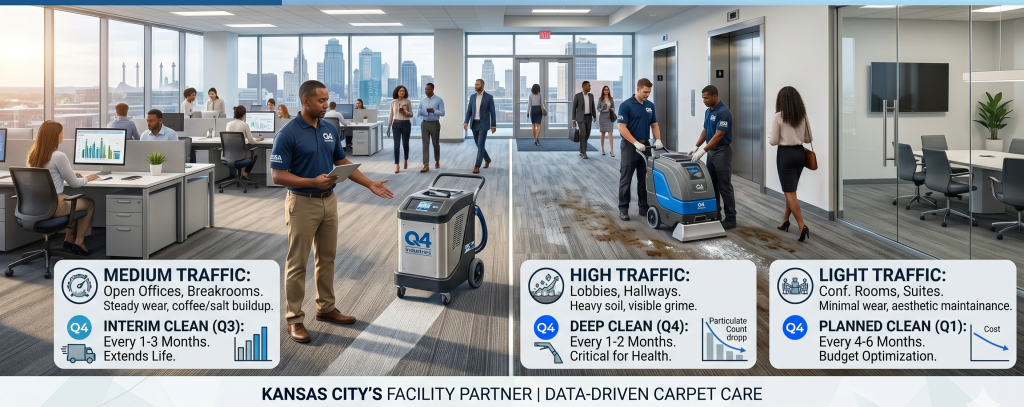
The industry baseline, supported by ISSA cleaning standards, comes down to foot traffic. Here is a practical starting point for most commercial office environments.
Light Traffic Areas
Private offices, executive suites, and conference rooms that see only a handful of people each day typically need professional deep cleaning every 12 to 18 months. Interim cleaning with encapsulation can stretch between deep cleans to keep the carpet looking fresh.
Medium Traffic Areas
Open office floors, workstation clusters, and break rooms tend to need deep cleaning every 6 to 12 months. These zones see steady foot traffic all day and pick up food crumbs, coffee spills, and heavier soil.
High Traffic Areas
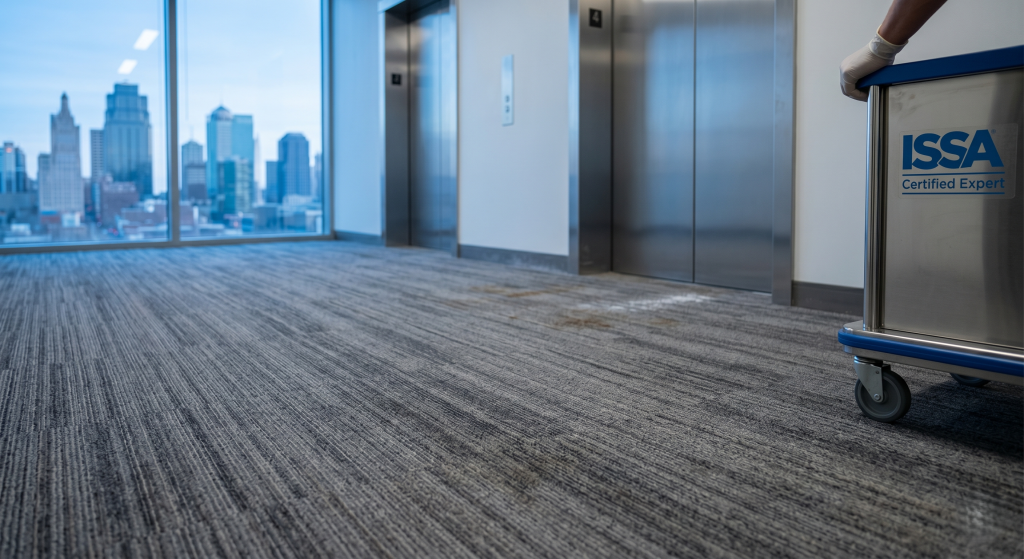
Main entrances, elevator lobbies, hallways, and reception areas need deep cleaning every 3 to 6 months. These are the first impression zones for visitors and they wear the fastest. Many facilities benefit from quarterly hot water extraction on these areas with encapsulation passes in between.
Factors That Shift the Schedule
Traffic is the biggest factor but it is not the only one. Several variables push the frequency up or down.
Climate and seasonality matter in the Midwest. Winter salt, summer mud, and spring pollen all load extra soil onto the carpet. Facilities in Kansas City often schedule a deep clean in early spring and another in late fall to catch the worst of it.
Industry also plays a role. Healthcare offices, pediatric practices, and food adjacent spaces tend to need more frequent attention due to hygiene standards and spill risk. A quiet accounting office will be on the lighter end of the scale.
Carpet construction matters too. Low pile, solution dyed commercial carpet hides soil and holds up to frequent cleaning. Plush or lighter colored carpet shows wear faster and may need more frequent attention to look acceptable.
Finally, entry matting is a major multiplier. A three section walk off mat at every entrance can capture up to 80 percent of incoming soil, which extends the time between deep cleans.
Interim vs Restorative Cleaning
Deep cleaning is not a single method. A strong carpet care program layers two types.
Interim cleaning, such as encapsulation or bonnet cleaning, is fast, low moisture, and keeps the carpet looking fresh between deep cleans. Most offices run interim cleaning every 30 to 90 days in high traffic zones.
Restorative cleaning, typically hot water extraction, is the deep clean that removes embedded soil, allergens, and cleaning residue. This is the service that resets the carpet and extends its useful life.
Running both on a rotating schedule is almost always more effective than relying on restorative cleaning alone.
Common Mistakes Facility Managers Make
A few habits shorten carpet life more than anything else.
Waiting until the carpet looks dirty. By the time soil is visible, thousands of abrasive particles have already been grinding against the fibers.
Skipping interim cleaning. Deep cleaning twice a year is not a substitute for regular maintenance in between.
Using the wrong method for the fiber. Some carpets do not tolerate high moisture extraction well. Always match the method to the manufacturer guidance.
Ignoring entry mats. Mats that are not cleaned or replaced on schedule push dirt into the building instead of capturing it.
Treating carpet care as a line item instead of a system. The most cost effective programs combine daily vacuuming, quality entry matting, quarterly interim cleaning, and scheduled restorative cleaning.
Frequently Asked Questions
How often should office carpets be professionally deep cleaned?
Most commercial offices should plan on hot water extraction every 6 to 12 months in medium traffic areas and every 3 to 6 months in high traffic zones. Private offices can go 12 to 18 months between deep cleans.
What is the difference between interim and deep cleaning?
Interim cleaning uses low moisture methods like encapsulation to refresh the carpet quickly. Deep cleaning, usually hot water extraction, removes embedded soil and resets the carpet. Most effective programs use both.
How do I know when my office carpet needs cleaning?
Visible soil, traffic lane darkening, stubborn odors, and longer drying times after spills all signal that a deep clean is overdue. Do not wait for all four before acting.
Does professional deep cleaning damage carpet fibers?
When done correctly with the right equipment and solutions, deep cleaning extends carpet life. Damage usually comes from over wetting, wrong chemistry for the fiber, or skipping the pre vacuum step.
How long does office carpet take to dry after cleaning?
Modern truck mounted extraction equipment typically leaves carpet dry in 2 to 6 hours. Air movers can shorten that further. Schedule overnight or weekend cleaning to avoid disruption.
Building Your Carpet Care Program
Frequency is not a one size fits all number. It is the output of traffic, industry, climate, and the quality of daily maintenance. A sound rule of thumb for most Kansas City and Midwest offices looks like this: quarterly interim cleaning on high traffic areas, a restorative deep clean twice a year, and annual attention for private offices and quieter zones.
The right supplies and equipment make the whole program easier to run. Q4 Industries has been supporting facility managers across the Kansas City metro and the Midwest since 2003 with ISSA certified expertise, wholesale pricing on the carpet care brands the industry trusts, and reliable delivery when you need it.
Ready to build a carpet care program that protects your investment and keeps your office looking sharp? Contact the Q4 Industries team to talk through your facility, your traffic patterns, and the supplies that will fit your schedule.