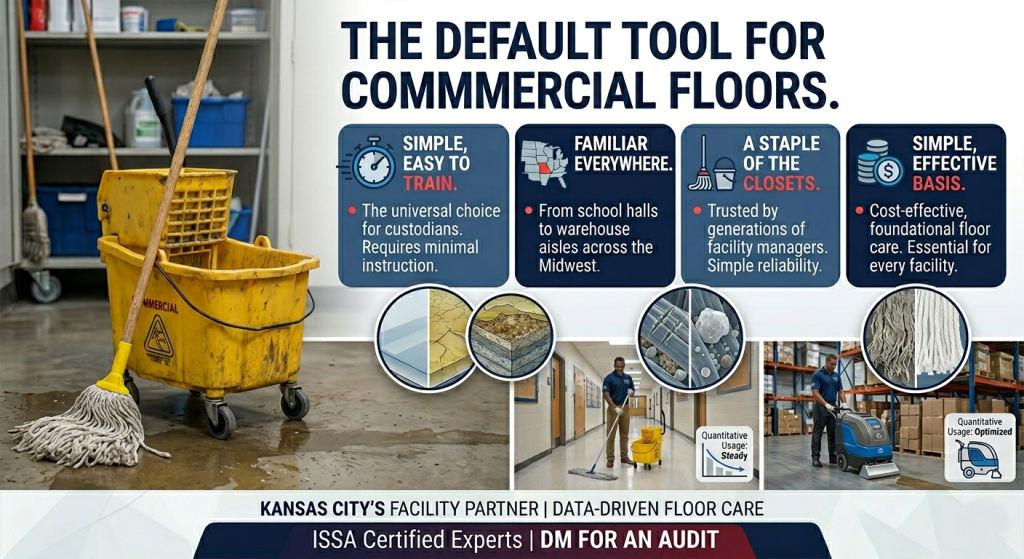
For fifty years, the mop and bucket has been the default tool for cleaning commercial floors. It shows up in every janitor closet from Kansas City to the far edge of the Midwest. Every school, every office, every warehouse. It is simple, easy to train on, and familiar to every custodian in the country.
It is also, quietly, one of the most expensive tools still in use.
Mop and bucket cleaning burns labor hours, spreads soil across the floor it is supposed to clean, keeps surfaces wet longer than operations can afford, and wears down the people pushing it across the building. Run the numbers honestly and most commercial facilities are paying a premium to hold on to a method that has been outperformed for years.
5 Signs Your Mop and Bucket Is Costing You Money
Here are five signs your mop and bucket is quietly costing you money, and what a modern auto floor scrubber can do about it.
1. Your Labor Hours Keep Climbing and the Floor Is Not Getting Cleaner
A mop moves across a floor at roughly 2,000 to 3,000 square feet per hour when a crew is working steady. The same crew can cover 15,000 to 21,500 square feet per hour with a walk behind auto scrubber. That is five to ten times the output from the same labor hour.
Labor is almost always the largest line item in a facility budget. When cleaning a 20,000 square foot building takes an eight hour shift with mops, that same building can be done before lunch with the right auto scrubber. Everything the custodian did not have to do on the mop becomes restroom turns, trash collection, disinfection rounds, or any of the other tasks that constantly slide.
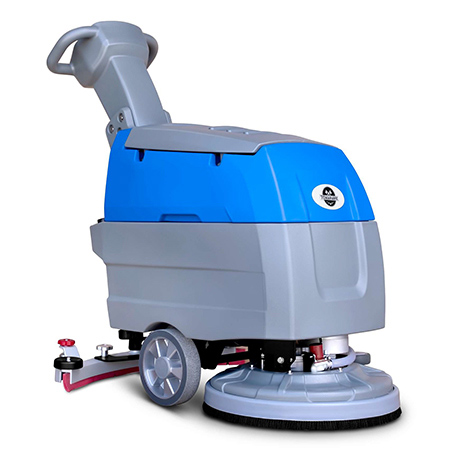
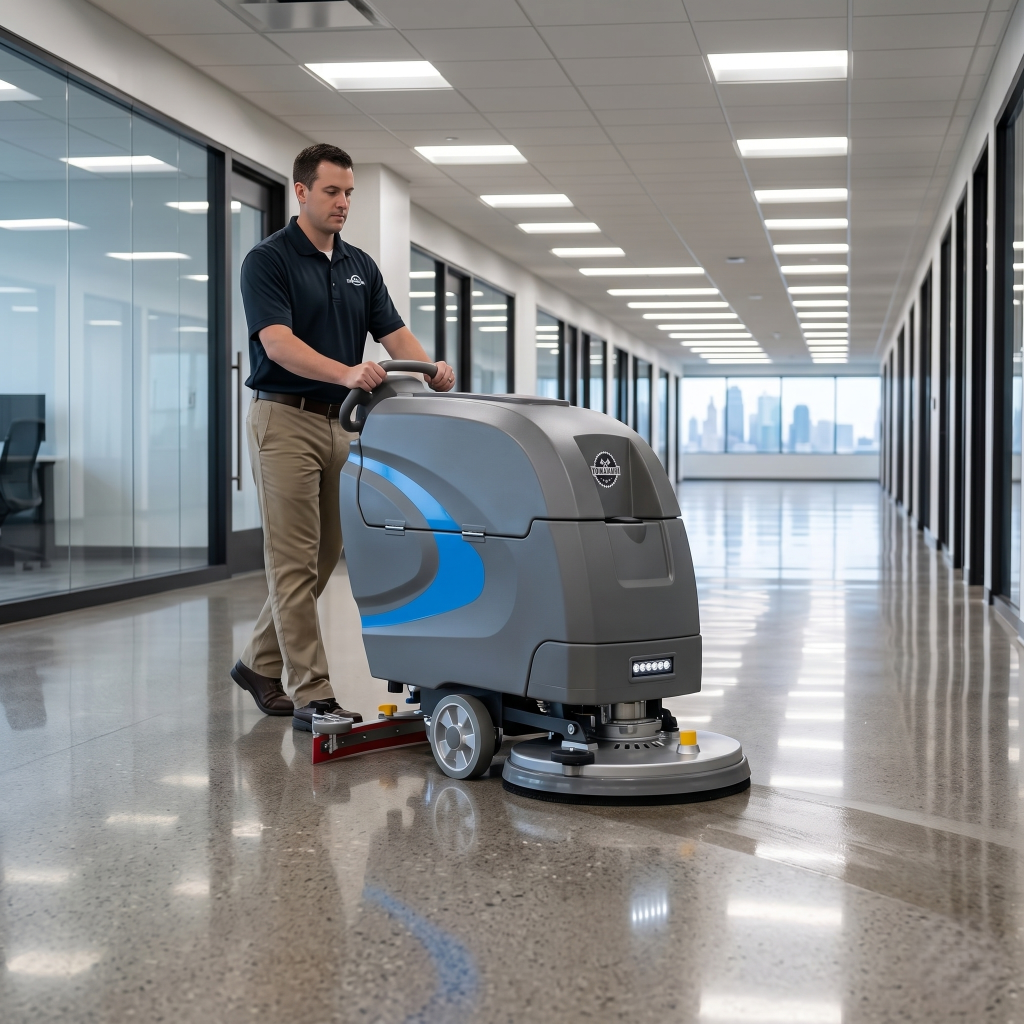
The fix: A machine like the Tomahawk TAS850e covers up to 21,500 square feet per hour with a 20 inch brush and a 32 inch scrubbing path, turning what used to be a full shift into a fraction of one.
2. The Mop Water Is the Cleaning Water
Watch a mop bucket after an hour on a dirty floor. The water is gray, then brown, then black. Every dip into that bucket re-deposits a thin layer of dirty water back onto the floor. You are effectively polishing the building with soil.
Auto scrubbers solve this at a structural level. Clean solution comes down from a dedicated tank, the brush agitates, and a squeegee pulls the dirty water up into a separate recovery tank before it can dry or spread. The floor left behind has never seen dirty water.
The fix: The TAS850e runs 14 gallons of clean solution and recovers into a 16 gallon tank. Clean water on, dirty water off. The floor stays cleaner for longer because the soil actually leaves the building.
3. Drying Time Is Disrupting Operations
Mopped floors stay wet for 15 to 45 minutes depending on humidity. In a hospital corridor, a school hallway, or a retail floor, that is 15 to 45 minutes of slip hazards, blocked traffic, and wet floor signs that undermine the professional look of the space.
Auto scrubbers leave floors nearly dry on the pass because the squeegee recovers the solution in real time. Traffic can return to the area in minutes, not half an hour.
The fix: The TAS850e scrubs and recovers in a single pass. Operations can resume right behind the machine.
4. Physical Strain Is Costing You in Turnover and Injuries
Pushing a mop across a commercial floor for hours is brutal on shoulders, wrists, elbows, and lower backs. The repetitive motion, the weight of a saturated mop head, and the lifting and dumping of full buckets all add up. Custodial injury and turnover rates are among the highest in the service sector, and they start costing the facility in workers compensation, overtime coverage, and recruiting long before anyone connects it back to the equipment.
A walk behind auto scrubber does the work. The operator walks upright and steers, and the machine applies the pressure, agitation, and recovery.
The fix: The TAS850e is cordless and battery powered with a quiet 68 decibel or lower noise rating. Operators walk, they do not push and lift, and the machine handles the load. Forward speeds up to 3.7 mph keep the pace brisk without straining the operator.
5. Chemical and Water Consumption Are Higher Than They Need to Be
Mops waste cleaning solution. They get over saturated, they drip, and they get wrung out into buckets that have to be dumped and refilled repeatedly. Meter the chemical usage on a mop operation for a month and the numbers are almost always higher than expected.
Auto scrubbers meter solution directly onto the brush at a controlled rate. Eco modes, flow controls, and closed tank systems use only what the brush needs. The same building cleaned with the same chemistry uses measurably less product on an auto scrubber.
The fix: The TAS850e includes an eco mode that dials back flow and suction for routine cleaning, stretching each tank further and lowering chemical spend without sacrificing results.
What to Look For When You Upgrade
Not every auto scrubber fits every facility. A few criteria worth keeping in mind when you evaluate options:
- Deck width. A 20 inch brush fits through standard commercial doorways and works well in offices, schools, hallways, and mid sized retail floors.
- Battery runtime. Look for at least two hours to cover a shift without a swap. Three hours gives a comfortable margin.
- Tank sizes. A 14 to 16 gallon class machine covers most mid sized buildings on a single fill.
- Noise level. 68 decibels or lower allows for daytime cleaning in occupied spaces like hospitals, schools, and libraries.
- Versatility. The machine should run on hardwood, laminate, tile, and sealed concrete without swapping attachments.
- Serviceability. Squeegee blades, brushes, and batteries should be easy to source through your distributor.
The Tomahawk TAS850e floor scrubber checks every one of these boxes, which is why it has become a smart first step for facilities moving past mop and bucket cleaning. Cordless operation, a 24 volt lithium battery with up to three hours of runtime, a 14 and 16 gallon tank pair, daytime friendly noise levels, and a versatile surface range cover the situations most commercial buildings actually face.
Common Mistakes When Moving Past the Mop
Buying more machine than the building needs. A ride on scrubber for a 15,000 square foot facility wastes budget. Right sizing to the space and the doorway widths matters more than raw horsepower.
Forgetting to train. Auto scrubbers deliver most of their value when the crew actually uses them. Build training into the rollout and keep the quick reference card near the machine.
Skipping daily maintenance. Empty the recovery tank, rinse the solution tank, flip or replace the squeegee blade, and the machine will serve for years. Skip those steps and the recovery will smell, the squeegee will streak, and the brush will wear unevenly.
Keeping the mop bucket for the wrong reasons. Small spills and restrooms still need a mop. The floor scrubber replaces the long corridor work, not every cleaning task in the building.
Frequently Asked Questions
How much can an auto floor scrubber save compared to a mop and bucket?
Most facilities see a five to ten times improvement in square feet per labor hour. The exact savings depend on building layout and traffic, but labor reductions of 50 to 75 percent on floor cleaning are typical.
Can an auto scrubber clean a floor while people are in the building?
Yes, if the machine is quiet enough. Models rated at 68 decibels or lower can run in occupied healthcare, retail, and education environments without disruption. The TAS850e sits at or below that threshold.
Is a cordless battery powered scrubber as powerful as a corded model?
Modern lithium ion scrubbers match corded performance on brush motor speed, suction, and run time for most commercial applications. The TAS850e runs dual motors at 550 watts on the brush and 500 watts on the suction with a 24 volt lithium system.
What kinds of floors can the TAS850e clean?
The machine works on hardwood, tile, laminate, and sealed concrete. Always confirm chemistry and pad or brush selection with the finish manufacturer guidance.
How long does the battery last on a single charge?
The TAS850e lithium battery provides up to three hours of runtime on a full charge, which covers most single shift applications before a recharge is needed.
Time to Stop Paying the Mop Tax
Every month a facility keeps running on mop and bucket cleaning is another month of labor, chemical, and productivity loss that better equipment would eliminate. The Tomahawk TAS850e auto floor scrubber puts commercial auto scrubber performance in reach of facilities that have never made the upgrade, with a cordless lithium design, a three hour battery, and a footprint built to move through standard commercial doorways.
Q4 Industries has been helping Kansas City and Midwest facility managers make this exact transition since 2003, pairing ISSA certified expertise with the equipment, chemistry, and pad recommendations that hold up in the field.
Ready to see what it looks like on your floors? Contact the Q4 Industries team to walk through your facility and find the right scrubber configuration for your building.